
Project L Review
If you like puzzles, engine-building, projects, high quality components, Tetris, or Chiclets gum, Project L (2020) just may be for you. And if you don’t like some of those things, but adore others . . . Project L still might be for you. But if you get in your car and you are on your way to a game night and notice someone following you with high beams blazing, perhaps the government has you marked for a different type of “project” altogether. Maybe. Probably not. But maybe. More on this later.
PeteSteele: Hey Sarah, what would you say if I told you I were into puzzles now?
SarahVasa: I would say you are a liar.
PeteSteele: But what would you say if I told you I were into puzzle games now?
SarahVasa: I would say that you had doubled down on your lie.
PeteSteele: Well, that just speaks to the fact that you don’t know me as well as you think you do. And that the game industry is constantly developing new board games that may pique the interest of people who thought they had closed the door on a particular genre for themselves or their gaming group.
SarahVasa: . . .
PeteSteele: I’m going to prove it to you. After I write this review, I’m going to get the whole Corax & Coffee gang together to play Project L.
SarahVasa: Whatever. Just email me the review when it’s done so that I can edit it. And make sure you don’t recommend that people chew on the game components or some nonsense.
PeteSteele: I am going to break with tradition here and almost undercut the rest of the review to say this from the get-go: Unless you would rather be an unwilling participant in a top secret government research project than go anywhere close to anything resembling a puzzle game, go pick up a copy of Project L (2020), immediately. And if you would rather be strapped to a table in an underground laboratory funded by your own tax dollars than play a puzzle game, I implore you: read the rest of this review and then reexamine your convictions. Ready? Let’s dive in.
Project L, designed by Michal Mikeš, Jan Soukal, & Adam Spanel, developed by Boardcubator,and published by Asmodee, is mainly about putting Tetris-shaped, Chiclets gum-looking* plastics pieces into well-crafted, recessed cardboard tiles in order to gain additional pieces to place in more well-crafted, recessed cardboard tiles in order to, ultimately, score the points, and thus win the game.
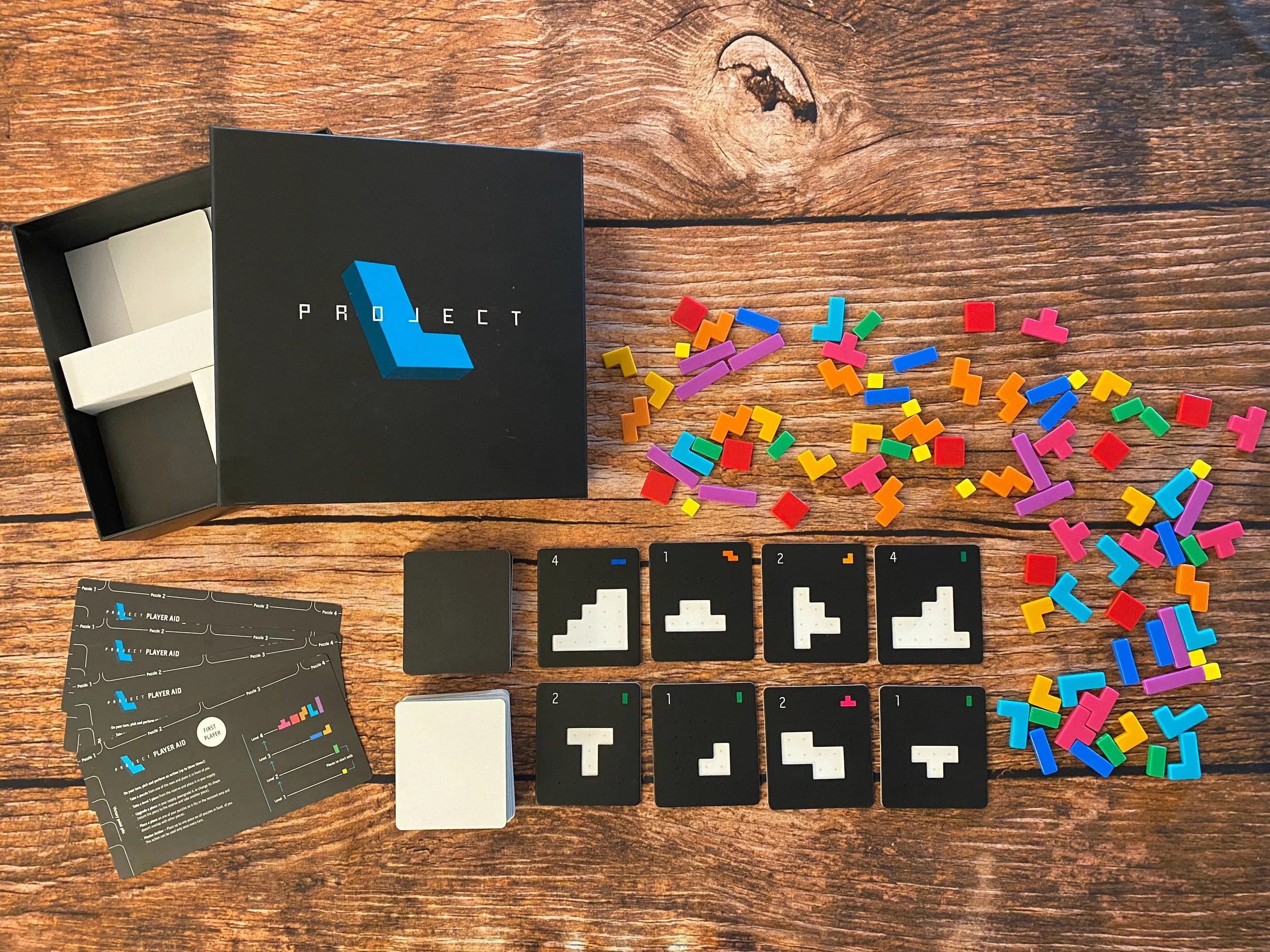
*Seriously, they just look like gum pieces. Do not put them in your mouth or chew on them.
Admittedly, the box art for Project L does not look compelling, but it does look professional. Sleek. Efficient. Almost German-engineered. While on first, second, and even third glance, you might not be particularly excited to discover the contents within, I think the box presents an air of mystery, which left me wondering, “So . . . seriously: what’s inside the box?” Well . . . 32 white puzzles, 20 black puzzles, 4 player mats, 90 colorful polyominoes (game pieces) (10 pieces of each of the 9 different shapes), and 1 rulebook. Reminder: Do not put the colorful, gum-appearing game pieces in your mouth.
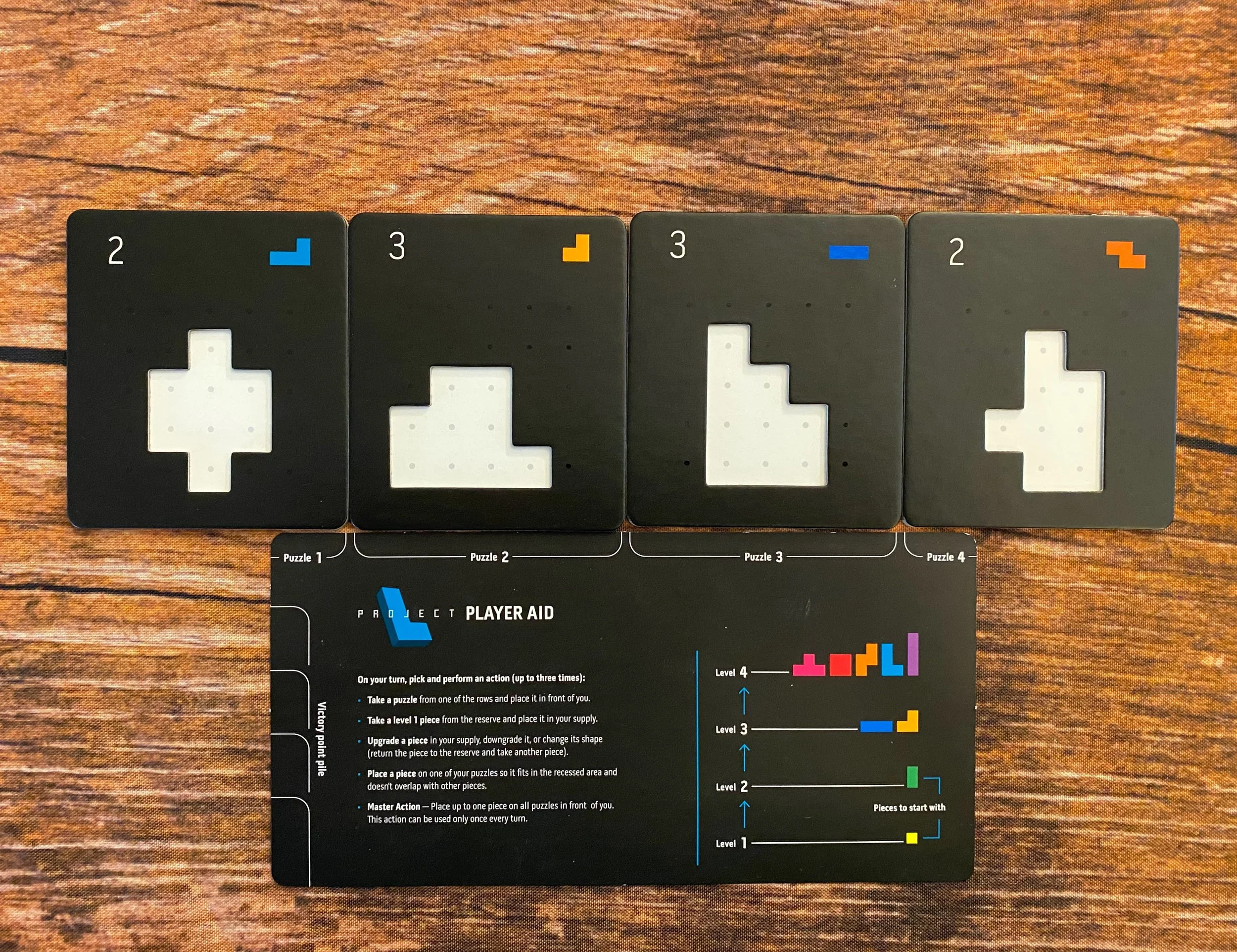
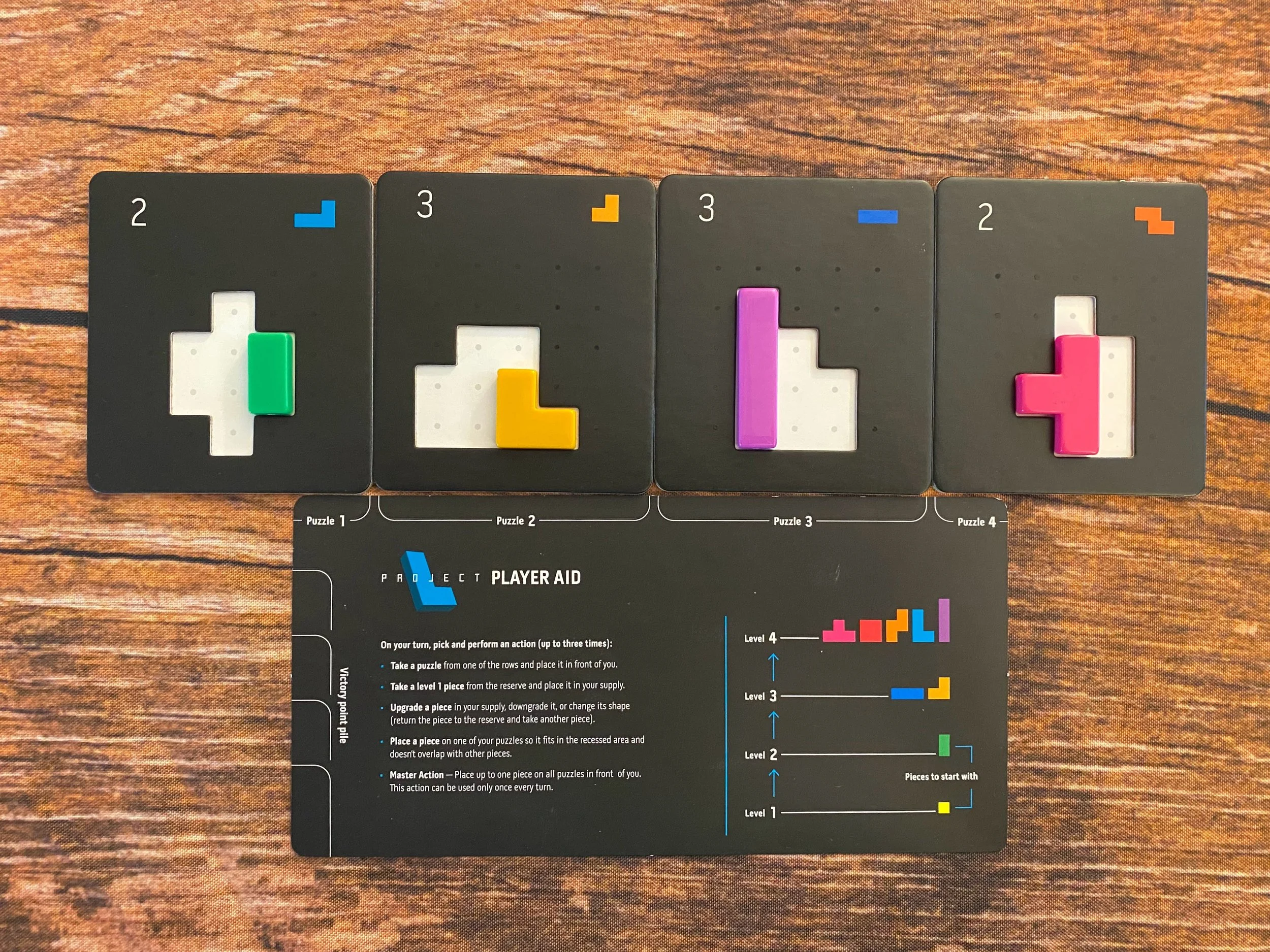
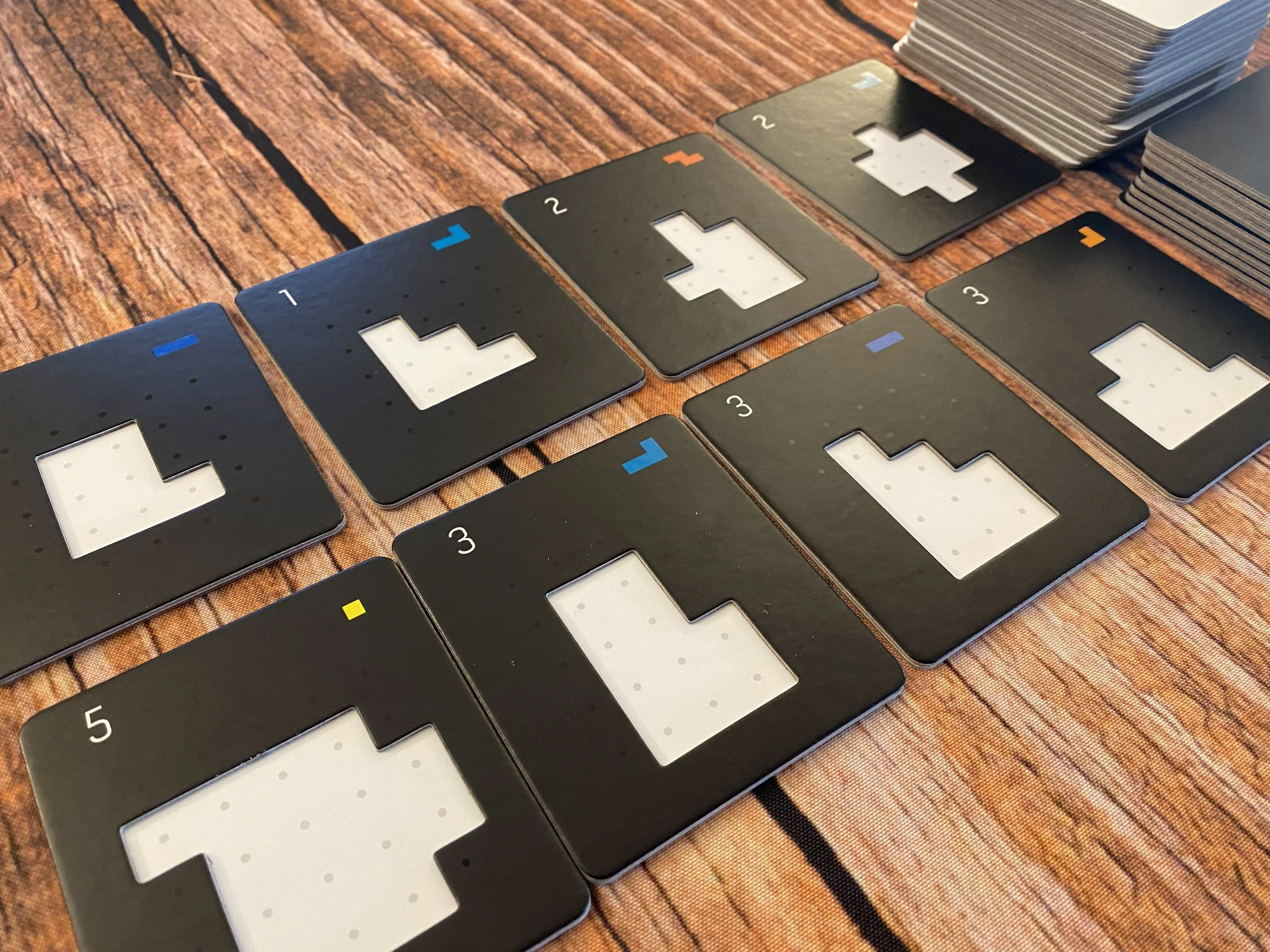
Players begin by creating two face-down piles to the side of the play space: a pile of black puzzles (deemed more difficult and worth a higher number of victory points) and a pile of white puzzles (deemed more basic). Next to each pile, players create a market of four respective puzzles face-up. Placed in front of each player is a player board and in between players are the multi-colored polyominoes in one large pile (or you can separate them out). Players start with one yellow 1-unit piece and one green 2-unit piece. When game play begins, players take turns completing three moves during their turn. Players choose from the following four actions: 1) selecting a card from the market to place at the top of their player boards if they have an open spot (each player board holds up to four puzzles), 2) placing one polyomino on one puzzle, 3) upgrading a polyomino piece as indicated on the player board, and 4) using a “Master Action” to place one polyomino in each puzzle they currently control. Players can perform an action more than once (e.g., taking two puzzle boards), but this will count towards the total number of moves. The “Master Action” is the only action that cannot be performed more than once per turn. If a player picks a puzzle from either market, the market is filled with a puzzle from the respective pile. When a player picks a black puzzle from the market which causes the black puzzle pile to be depleted, players finish that round, one more full round is played, and then players each have a “clean-up” step—a last-ditch effort to complete puzzles for points, but at a cost.
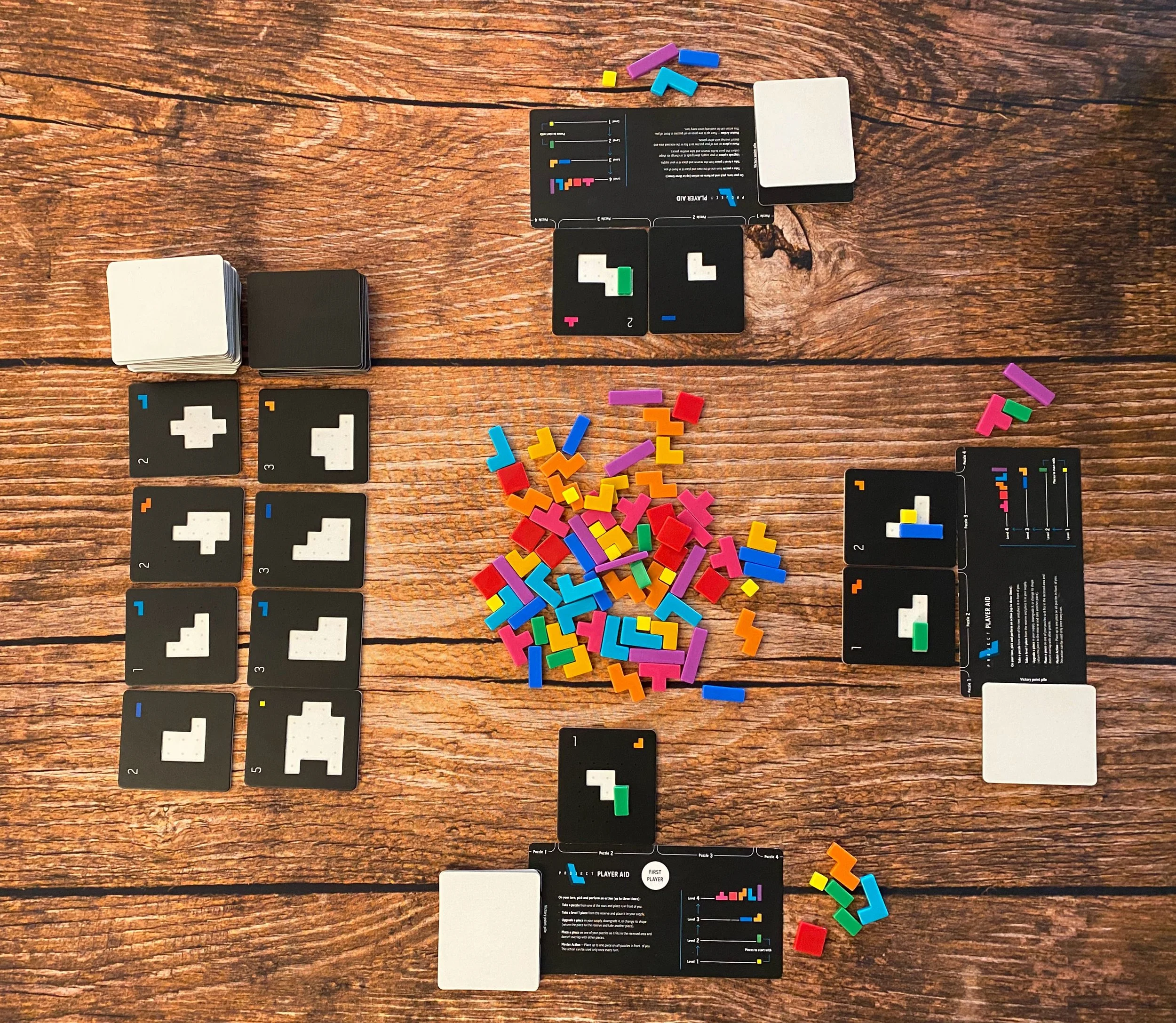
A game of Project L (2020) in progress for 3 players.
If you see the little colored polyominoes (the game pieces) and immediately think to yourself, I am bad at Tetris, therefore I hate Tetris, therefore I will be bad at this game, therefore I will hate this game, that would be a reasonable conclusion to come to based on the aesthetic of this game, to be sure. However, ultimately, your conclusion may still be incorrect as this game is nothing like Tetris.
Project L is a light and extremely quick and easy game to learn of action selection, market drafting, polyomino placement, and engine building. The goal of Project L is to use the polyominoes that you have to complete puzzles, which helps you gain more pieces to complete more puzzles. Each puzzle is worth a certain number of victory points, which are gained upon completion of the puzzle. At the end of the game, the player with the most victory points wins. In the event of a tie, the number of polyominoes that you possess determines the winner.
Yes, Project L is certainly an abstract game and does not have a theme of wading through puzzles, trying to uncover some sort of government conspiracy, solving murders, or anything like that. However, it is easy to learn, easy to teach, and can be played very quickly over a single cup of coffee. The contents of the box are beautiful, fun to play with, and, to a large extent, a mastercraft of engineering. To anyone wanting to hook puzzle goers into the world of gaming, or to anyone who just wants to quickly show a cool game to someone else, Project L is a good option.
SarahVasa: The game only lets you take a few actions per turn. I found that to be frustrating. I wanted to be able to do more on my turn!
PeteSteele: Even in a two-player game when your turn comes back around quickly?
SarahVasa: Yup. I found the limited number of actions per turn too restrictive. Not a fan.
PeteSteele: Well, there you have it, folks. Sarah and I were not able to come to an agreement on that particular point, as I found the restricted actions to add just the right amount of focus and frustration to my turns, but your mileage may vary.

How is this for a recommendation: After I opened up my copy of Project L, read the rules, and played one game, I hopped online, ordered a second copy, and shipped it to my dad. While there certainly are other metrics, it’s hard to give a stronger recommendation than immediately buying a second copy and sending it to someone who you think will enjoy it.
My dad played Project L a number of times with other members of the family. While they reported enjoying their experience very much, they also, very kindly, took the time to relay their experiences and offered their critiques to me. Normally, as a game reviewer, I would not stand for others to do so much of my job. But it’s vacation week and who am I to stand in the way of other’s voices—especially on a site where we value diversity of perspective. To that end:
Pete’sDad: The rules were succinct, but we found there were a few critical omissions.
PeteSteele: Such as?
Pete’sDad: The rules do NOT say, explicitly, what happens if a player takes a white puzzle piece causing the white puzzle pile to empty. We assumed that in that situation, the removed puzzle piece is not replaced. The “Game End” conditions allude indirectly to the fact that when the black puzzle pile is emptied, the four black puzzle pieces that are face-up remain available, but that seems to be the closest that the rules get to addressing the situation. It does not address if there is a “Game End” condition for the white puzzle pile.
PeteSteele: Hmmm. Anything else?
Pete’sDad: The rules DO say what happens if you try to upgrade a piece and there is no piece in the supply of the next higher level: you get to skip a level. But the rules do NOT say what happens if you are supposed to get a reward for completing a puzzle and the supply does not contain such a piece. But we ran into this problem only in our four-player games. After this experience, the opinion of all four players was that the game would play better if there were simply more green 2-unit length pieces in the supply.
PeteSteele: Yup. I can agree with that. Anything else?
Pete’sDad: We played the first game under the assumption that if there is no matching reward piece in the supply, you get no reward. This felt like it badly shortchanged the player who completed the puzzle. We played the second game under the assumption that if there is no such piece in the supply, you get an “automatic upgrade” of the promised reward. This felt like it overly rewarded the player who completed the puzzle—especially because one player was lucky enough to enjoy this upgrade twice in one turn (using a Master Action), and got two 3-unit pieces rather than two 2-unit pieces.
PeteSteele: Cool. Anything else?
Pete’sDad: Yes, stop joking about people putting game pieces in their mouths. Somebody is bound to try it and it is seriously not a good idea.
PeteSteele: Leave it to my dad to pick apart the rules to find all of the holes. Not only that, but to also find creative solutions to improve said rules based on the best overall mechanics as well as the designer’s intention. He really is the best type of rules lawyer. He and I have had many raucous debates about how to interpret certain rules in certain games. Learn more about positive and negative rules lawyers’ practices in Corax & Coffeecast #7 coming to a streaming service near you in just a few weeks. Also, we did some checking: Project L has a revised rulebook available on BoardGameGeek (and possibly other places) that goes at least part way to addressing the rules gaps.
Pete’sDad: So, now that I know that Project L has addressed the question of what happens when a reward is not present in the reserve in a revised rulebook, I withdraw my suggestion for extra green pieces. However, the revised rulebook still does not quite cover all cases because the recommended replacement might not be available in the reserve, either. It is unlikely, but could happen.
PeteSteele: See what I mean? Rules Lawy . . . well, rules fixer, really.
Pete’sDad: Anyway, I really love the game! I wouldn’t be sweating over these little details if I didn’t care about it!
PeteSteele: Well, I can agree with you on that. This is certainly a game worth caring about.
If you happen to win a streak of games in a row, you will be convinced the game is all skill. But, inevitably, you will start to get creamed by a family member or friend and you will likely shift your tone to now being convinced that Project L has shifted into a purely luck-based quagmire of color and missed opportunities. But either way, you will want to go for another game.
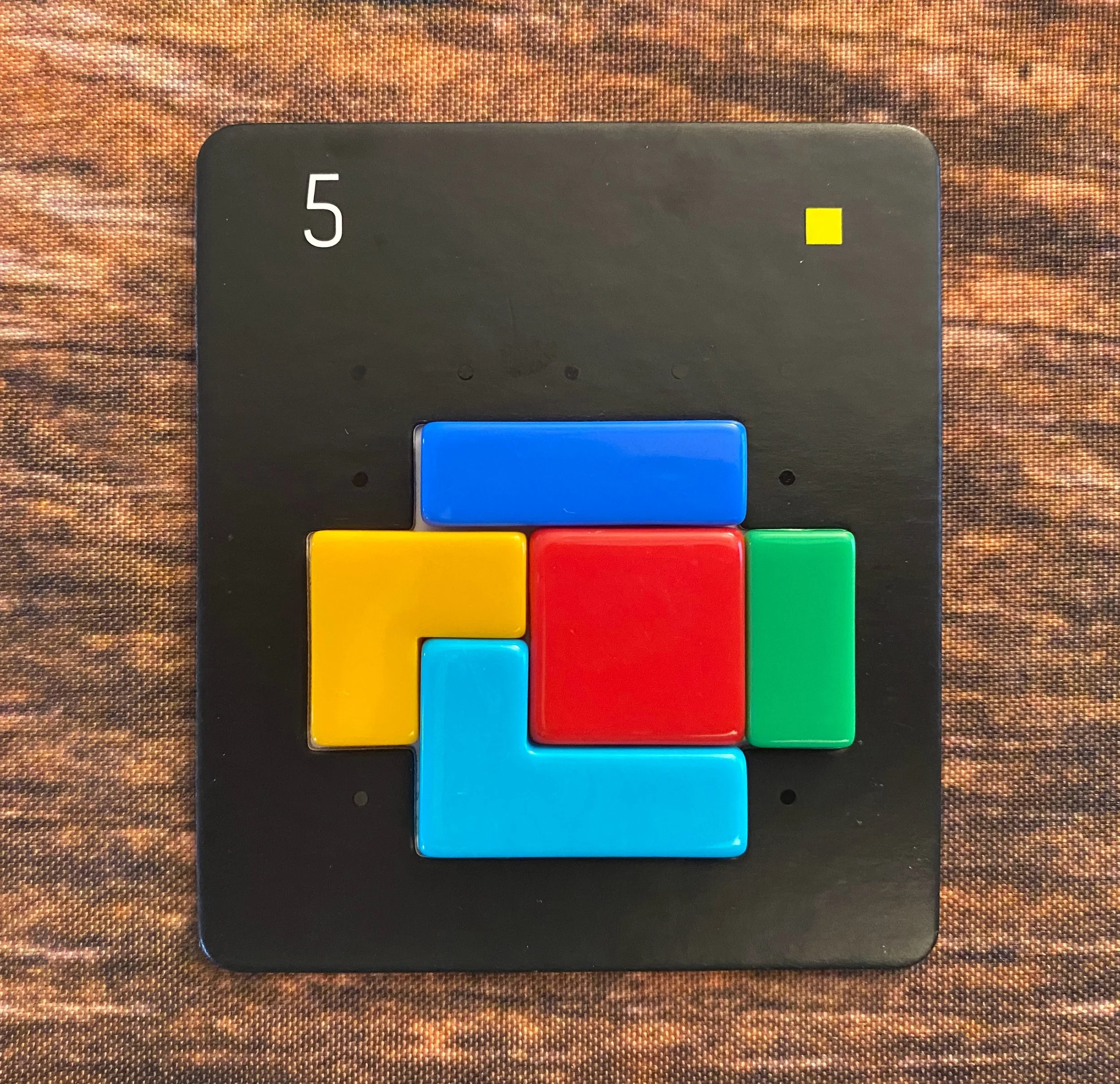
A completed puzzle worth 5 victory points with the reward of a 1-unit piece.
Project L is sleek, pretty, and almost completely ready to play out of the box. Yes, more components would have been good. And, yes, the front of the box looks minimalist and it certainly does not do justice to the incredible contents within. I almost passed this one by, but I am incredibly grateful that I did not. I hope you don’t pass it by either.
Minus a couple of holes in the rules that we have covered here, you’ll be up and playing Project L in no time. You can play first thing in the morning, last thing at night before you go to bed, or almost any other time.
I certainly wish there had been slightly more content in the box and would have gladly paid a higher price for it, had there been. In addition, this is certainly a game that I would blindly buy an expansion for. Speaking of, Boardcubator is in the process of producing four expansions for Project L: Project L: Ambassador Pack, Project L: Ghost Piece Link, Project L: Finesse Link, and Project L: Finesse Ambassador Pack. See you in line to scoop these up!
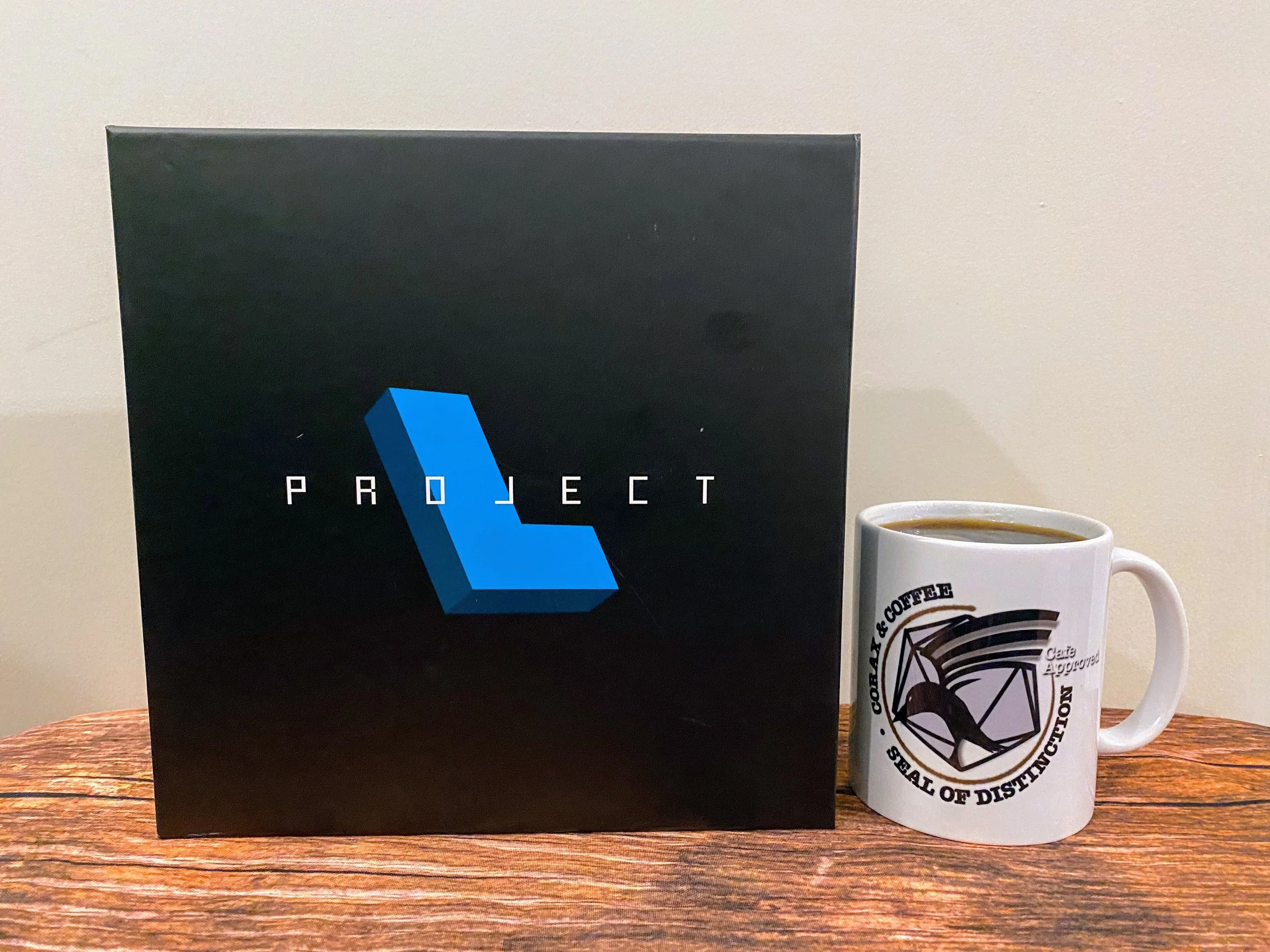
But expansion or not, with an MSRP of $34.99, we highly recommend that you check it out. We think this is a good game for puzzle gamers and non-puzzle gamers alike, and a perfect size, nor overly complicated, to play in a coffee shop. Also, no matter how colorful, do not put pieces in your mouth; the pastries are bound to be tastier. Always a good rule. With that, I am happy to award Project L the Corax & Coffee Seal of Distinction as well as our Cafe Approved banner. Finally: steer clear of shady government experiments.
Pete’sDad: Yes. Almost certainly a good idea.
PeteSteele: So, what did everyone think of Project L?
KeeganKing: Well, it’s better than Project MKUltra.
PeteSteele: Er—yes . . . that’s very true. Unethical and illegal human experimentation is much worse than—
RickHendricks: It’s also better than Project Sunshine.
PeteSteele: Well, yes, government-sanctioned corpse theft is also bad, but what about Pro—
Ms.Shaw: Oooo—The Stargate Project was kinda messed up!
PeteSteele: Look, can you all get off of your phones, stop cribbing government missteps from Wikipedia, and actually answer my question?
KeeganKing: I actually knew that stuff already. I’m on my phone ordering up my own copy of Project L.
Ms.Shaw & RickHendricks: Same here.
PeteSteele: Sarah? What did you think of Project L?
SarahVasa: Oh, hang on. I’m just Googling to see if they still make Chiclets gum. I have a hankering.

Project L earns our Seal of Distinction and is Cafe Approved!